The glass is removed from the tempering furnace once the process is complete, and everything appears to be in perfect condition. However, upon closer inspection, you realise that something is amiss: distorted reflections and undulations affecting the flatness of the surface. In short, the result is nothing like what was expected, and the sheet has to be discarded.
In many cases, the culprit is roller wave, a defect that originates inside the furnace during tempering and which unfortunately becomes apparent due to suboptimal handling.
Have you ever experienced this nightmare? If so, you certainly wouldn’t want it to happen again: having to discard sheets, wasting material and time on unexpected rework, and losing customers’ confidence in your work while they wait.
However, you can avoid all these problems by using specialised technologies to minimise the risk of tempering defects on glass sheets. Such technologies are found in Mazzaroppi furnaces.
What is a roller wave?
It is a surface undulation that forms on glass during the tempering process. It is not a random or unpredictable defect; rather, it is the direct result of the way the glass behaves when it is in a plastic state, i.e. at a high temperature, as it flows over the furnace’s transport rollers.
At this stage, the glass is extremely malleable. Local differences in pressure, temperature and speed between the rollers and the sheet of glass cause micro-bends to form, which repeat along the direction of travel. In the most severe cases, the result is visible to the naked eye: optical distortions, loss of flatness and altered reflections.
However, roller wave is not merely an aesthetic defect. It has tangible consequences for product quality and regulatory compliance. The European standard EN 12150-1, which governs toughened glass for the construction industry, includes a section dedicated to measuring roller wave and establishes maximum permissible values. Glass exceeding these limits is not considered compliant.
Roller wave is particularly critical in applications where optical quality is under constant scrutiny, such as curtain walls and structural glazing. In these contexts, the distorted reflection is visible to anyone passing by the building. Similarly, in high-end windows and interior glass features, aesthetic appeal is an integral part of the product, so such an imperfection would be unacceptable to the end customer. Finally, in automotive and display glass, optical tolerances are even more stringent. In all these contexts, glass with visible roller wave is not just imperfect; it is unsaleable.

So, how is roller wave detected?
This is not always straightforward: at first glance, the sheet may appear intact, and the defect only becomes apparent when the surface is observed at the correct angle or using specialised instruments.
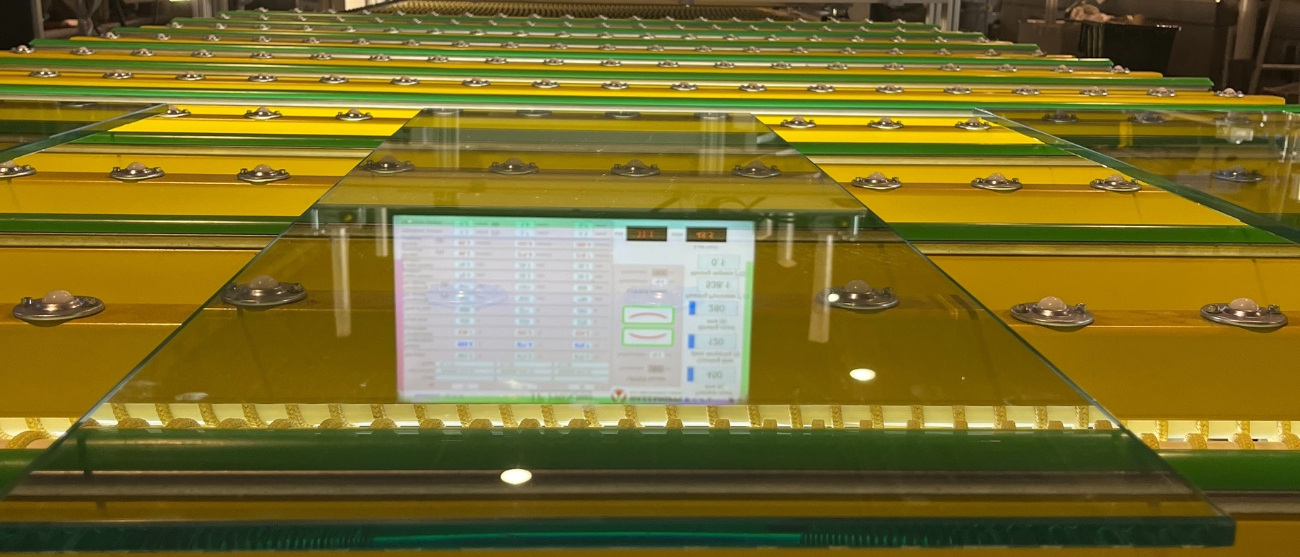
This is why Mazzaroppi systems are equipped with a zebra-striped optical panel at the furnace exit. This high-contrast striped pattern reflects on the surface of the sheet and reveals optical distortions and geometric deformations that would be invisible to the naked eye. This is a non-destructive, practical and particularly useful method of monitoring continuous production.
For those looking to go beyond visual inspection, Mazzaroppi systems can be integrated with automatic end-of-line scanners that can measure flatness, deformation and optical distortion in real time. This data can then be linked to systems that monitor the furnace’s operating parameters, thereby transforming quality control into a continuous, automated and traceable process. This ensures process repeatability and consistent quality standards.

Mazzaroppi’s technological solution to the roller wave problem comes into play at the most critical moment of the process
Mazzaroppi furnaces feature an intelligent, integrated glass handling control system based on continuously variable kinematics, which is capable of self-adjusting throughout the entire process cycle. The system does not use fixed parameters set in advance; it adapts in real time to the specific characteristics of each sheet of glass, such as type and thickness, by dynamically modifying accelerations, speeds and movement profiles.
All of this is made possible by high-precision servo motors, which enable precise control of each stage of the handling process. This control is particularly important during stages when the glass is at a high temperature and the risk of viscous deformation is greatest, as the sheet is most vulnerable at this point as it passes over the transport rollers.
The principle is simple: if micro-deflections causing roller wave arise from variations in pressure, speed and temperature between the roller and the glass, the solution is to ensure smooth, continuous, adaptive movement. By applying real-time control cycle by cycle and sheet by sheet, the mechanical and thermal stresses responsible for the defect are significantly reduced, resulting in a tangible and measurable improvement in the flatness and optical quality of the toughened glass. The proprietary Mazzaroppi technology that achieves this is called M No Roll – Roller Wave Intelligent Setting and was designed and tested by the Mazzaroppi technical team. Reducing defects is the most effective way to add value to glass, avoid waste and complaints, and ensure the consistent excellent quality of the finished product.
To ensure you’re getting the best results from your tempering process and that your system is truly energy-efficient, contact the Mazzaroppi team for a free Energy Saving Check.
This analysis of your furnace’s energy performance will tell you how much you could save on your energy bills by choosing a Mazzaroppi solution. If you don’t yet have a furnace, the check will show you how quickly you can recoup your investment with a Mazzaroppi system thanks to its low energy consumption and excellent hardening results.
Call us to find out more.


CEO Mazzaroppi Engineering Srl